
Out of autopilot
Your inner balance decides how you move through the day. Understand stress instead of just feeling it: why your body is sometimes on alert – and what it's trying to tell you.
Stress is a natural response – it helps you react, perform and function. The problem doesn't come from stress itself, but from when your body can no longer find a counterbalance.
MYnextRING helps you understand exactly this balance better – by showing how your body responds to strain and when it moves back into recovery.

Stress is measurable – even before you feel it
Stress often begins in the body before you consciously notice it. You keep functioning, get things done, go through your day and only realise later that your system has long been under pressure.
Your body is constantly responding to strain and recovery. MYnextRING detects these changes in:
- Heart rate
- Heart rate variability (HRV)
- Body temperature
- Activity patterns
- Sleep quality
Stress rarely appears out of nowhere. Usually it announces itself through small changes in your sleep, your energy or your resilience. When you recognise these signals, you can respond earlier: with breaks, movement or deliberate rest. Not only once your body forces you to.
And this is exactly where MYnextRING comes in
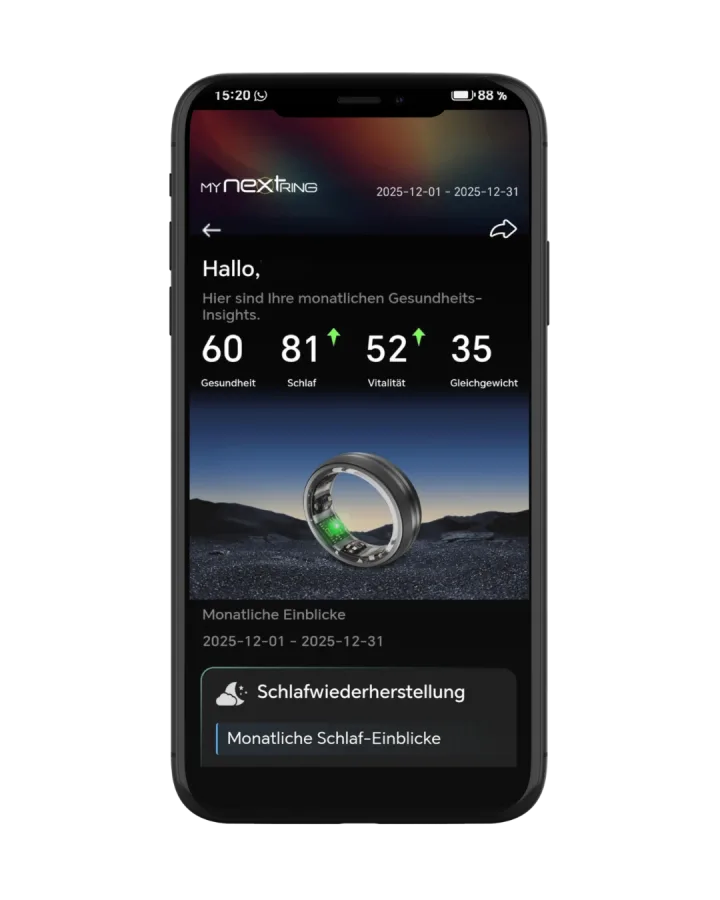
MYnextRING makes your autonomic balance visible. Based on your heart rate variability (HRV), your activity and your recovery phases, the ring shows you how your body responds to your everyday life – not in isolation, but in context.
So you can see:
- when your body moves into activation
- when it truly regenerates
- how strain builds up over the days
- and when your system returns to equilibrium
A picture of your autonomic balance emerges – the interplay between activation and regeneration.
Not all stress is the same
For your body, stress isn't only mental. Physical strain counts too: training, too little sleep, travelling or long days without a break. What matters isn't where the stress comes from – but whether your body can wind down again afterwards. Your body distinguishes between two kinds of stress:
- Eustress – the good stress: it activates you, makes you focused and capable. It helps you grow beyond yourself.
- Distress – the burdensome stress: it arises when your system can no longer find enough recovery. Then everything feels harder, even if objectively nothing has become “more”.
Both forms are part of it. What matters is the ratio between them.

Stress follows a pattern
Many people think stress comes at random. In truth, your body shows clear responses – across the day, across the week and across your habits.
Stress is rarely just “too much work”. Often it's a mix of many small factors: a long working day, little real recovery, poor sleep, constant mental strain, an intense workout or too little movement – all of that influences how your system responds. Your body combines all of it into a single signal: stress level. MYnextRING helps you recognise these connections and encourage positive patterns.

Stress isn't your enemy – a lack of recovery is
Your body is designed to alternate between performance and rest. It only becomes a problem when these switches fall out of rhythm. Don't wait to respond until your system is already overloaded.
Many people try to “manage” stress. But the difference doesn't come from control – it comes from awareness. Understanding instead of judging is the creed: a single day says little, but your body tells a story over time.
See how your life changes.